Blockquote: the answer your website forgot to give
Arne Kellmann · · about 8 min read
Share
Synthetic voice · Open / download MP3
A web designer offers a “complete website package”. You are ready to ask for a quote, but one thing is missing: who writes the text?
This is an invented example, but the question is concrete. If you have to supply every paragraph, the project requires time you may not have budgeted for. If copywriting is included, you are comparing a different service. “Complete” leaves both possibilities open.
Blockquote, my website auditing tool, examines a public page for its structure, machine-readable information and citability: whether its statements are clear, supported and understandable when quoted elsewhere. The useful audit is the one that helps you separate a missing fact from a missing label. Adding labels to an unexplained offer will not explain it.
The missing sentence
The designer’s hypothetical service page promises:
We create exceptional digital experiences. Our complete package takes care of everything, so you can focus on what matters.
The missing scope extends beyond the text. Who supplies photographs? Who maintains the website after launch? Nothing in this paragraph lets the prospective customer plan the work or compare a quote.
Here is a more useful version, still hypothetical:
The website package includes design, development and the transfer of your existing text and photographs. You supply the content. Ongoing maintenance is quoted separately.
The second version makes a smaller claim and gives the reader much more to use. Someone who needs a copywriter can ask about one before accepting a quote. An assistant comparing packages can describe the scope without guessing what “everything” means.
Being accessible, understandable and worth citing are three different things
A public page can fail at several different points. Treating them all as “AI visibility” makes it harder to choose a repair.
Access comes first. Can the system retrieve the page’s content? A visitor may see a service description after signing in, while a public crawler sees only the login screen. Google’s technical requirements distinguish access, a working response and indexable content. These are entry conditions for its search system, not proof that a page deserves a particular position.
Meaning comes next. A crawler can retrieve every word of “our complete package takes care of everything” and still have no answer to the copywriting question. This is an editorial problem. Changing a setting or adding machine-readable labels does not supply the missing terms.
Usefulness as a source is another judgment. “The customer supplies the text” can answer a question about this designer’s package. It provides no evidence for a broader claim such as “all web designers expect customers to supply text.” The statement has a scope. A useful citation has to respect it.
These distinctions suggest an order of work: make the content accessible, make the answer explicit, then check what the answer can actually support. A clear sentence behind a login and a public paragraph saying nothing useful require different fixes.
Looking past the large number
Blockquote returns a score from 0 to 100. Underneath it are three categories: schema, structure and citability. In everyday terms, those cover the information software can read about the page, how the page is organised, and how well the text supports being quoted.
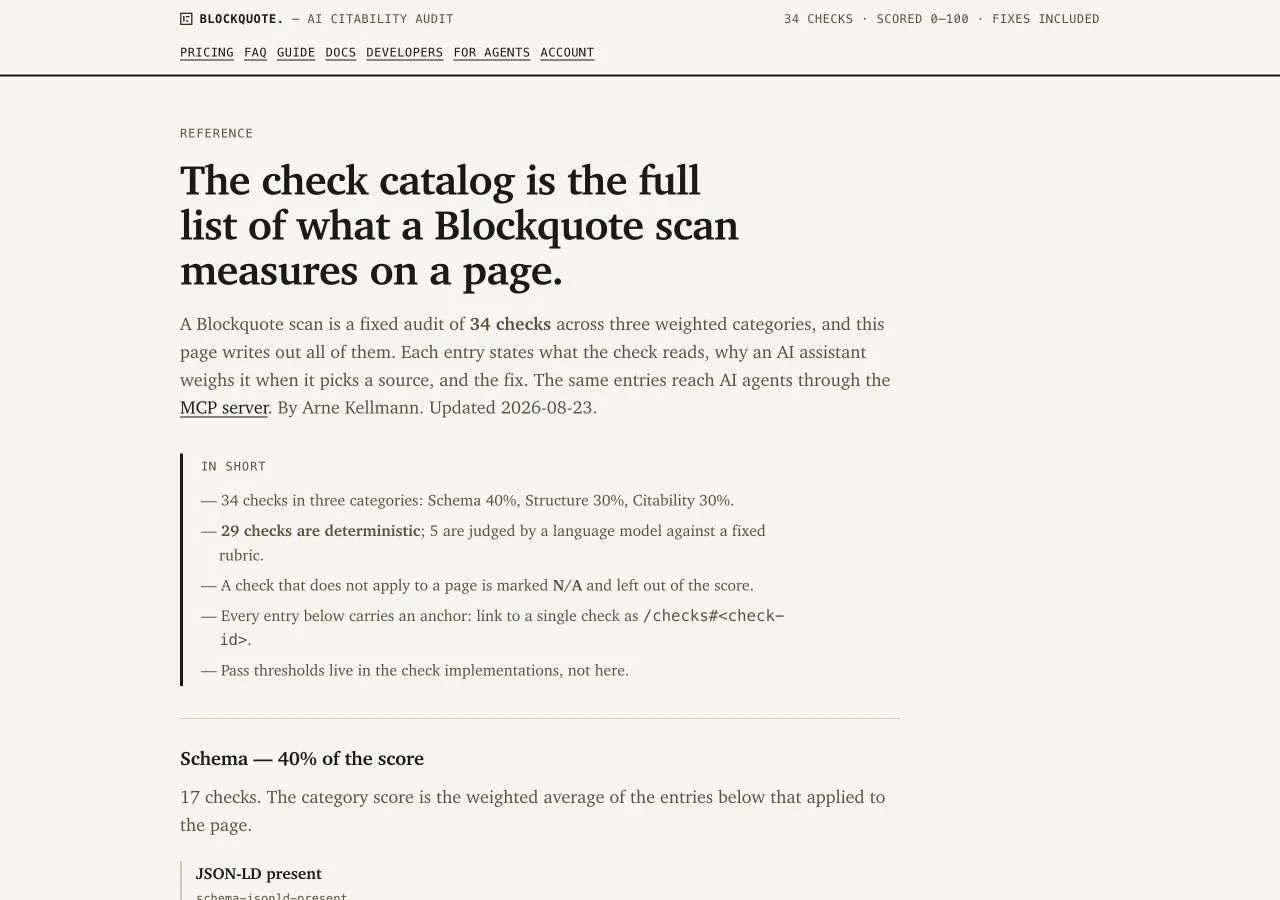
The public methodology describes the checks and their weighting. The check catalog goes further, naming the individual tests. Some inspect concrete features, such as whether the page names an author. Others use a language model to assess the writing. The report distinguishes those judgments, and checks that do not apply to a page are excluded.
That detail is more useful than the total on its own. A missing author and an unclear sentence are different problems. One calls for identifying who wrote the page. The other needs an editor to decide what the sentence should say.
On this service page, the unanswered scope question deserves attention before another subheading. The report can flag weaknesses in how a page explains itself; the designer still has to supply the actual terms. A scan cannot decide whether copywriting belongs in the package.
A worked review of the designer’s paragraph
The following is an editorial walkthrough using Blockquote’s published checks, not a scan result. The designer and package are hypothetical. I have not assigned a before-and-after score or claimed that any check passed.
Start with a direct answer near the top. The first version praises the service but withholds its scope. Put the inclusion paragraph near the package heading so a reader comparing offers can find it. This changes where the answer appears as well as what it says.
Next consider pronoun clarity and quote extractability. “It includes this too” may work beside a graphic. Away from that graphic, both references disappear. “The website package includes the transfer of your existing text and photographs” names the service and the work. The sentence is longer but carries its own context.
Now look at fact density. The revised paragraph adds three decision-relevant facts: what is included, who supplies content, and how maintenance is handled. Those facts must come from the designer’s real offer. Filling the space with invented turnaround times would make the text more specific and less trustworthy.
Finally, distinguish the visible explanation from structured data, the labels software can read about the page. If those labels describe a service that includes copywriting while the visible terms say the customer supplies text, the two accounts conflict. Google’s structured-data guidelines require the markup to represent the page accurately and reject misleading or invisible claims. A valid format cannot rescue false information.
The resulting review has two separate conclusions. We can read the revised paragraph and verify that the scope is clearer. Whether the page meets every automated threshold remains a question for an actual scan. Keeping those conclusions separate prevents an editorial example from turning into invented product evidence.
The temptation to write for the score
Once a tool assigns a number to writing, it becomes tempting to write for the number. Add a heading. Add a list. Repeat the product name. Keep going until the report is green.
A page can become worse that way. Consider a short cancellation policy. If it clearly states when a customer can cancel and what happens to payment, adding a long history of the business may make the answer harder to find. Likewise, adding three irrelevant source links can improve a count without supporting a single claim. The format of evidence is not its relevance.
There is a second problem: a polished page can contain an incorrect claim. An author name, orderly headings and valid markup do not establish that the author is right. Blockquote is a page audit, not an endorsement of the business or an independent fact-check of every sentence. Check the substantive claim against its source; use the report to examine how the page presents it.
The score reports performance against Blockquote’s rubric. It does not establish that ChatGPT has cited the page or that search traffic has improved. That is the limit of what this audit measures.
Google’s own guidance for AI features in Search is helpful here: the established search fundamentals still apply, and there are no extra technical requirements for appearing in AI Overviews or AI Mode. Discoverable pages, accessible text and accurate structured data remain worthwhile. An audit can help inspect those things; it cannot choose which sources a search system will use.
Start where a customer has to make a decision
For a first scan, choose the page that explains a paid offer. Keep the actual customer question beside the report. In the designer’s case, “Who writes the text?” is a reason to improve the scope paragraph even if that change does not produce the largest score increase.
Make the edit, then read the surrounding paragraphs. Does the explanation still flow? Did clarifying the package reveal a contradiction further down the page? Rescanning can check the changes against the rubric, while that second read catches problems a score may miss.
This is also worth doing before paying to send visitors there. My NowYourLink article looks at buying a single advertising placement. The destination still has to explain the offer once someone arrives.
You can scan a public page with Blockquote and inspect the findings. For our designer, the useful result is a sentence as plain as “You supply the content.” The customer now knows what to prepare, and the quote can be discussed on that basis.
Product details checked on 22 September 2026 against the linked methodology and check catalog. I build Blockquote.