NowYourLink: what a single advertising slot changes
Arne Kellmann · · about 9 min read
Share
Synthetic voice · Open / download MP3
Suppose you sell a booking calendar for independent music teachers and have €25 net to try an advertising placement. The product lets a teacher offer lesson times and a student book one. That should be straightforward to advertise.
Then you open the campaign settings. Audience, placement, creative variations, optimisation goals: the small test has acquired a setup project. For this hypothetical business, the question is whether one homepage slot would be worth that €25.
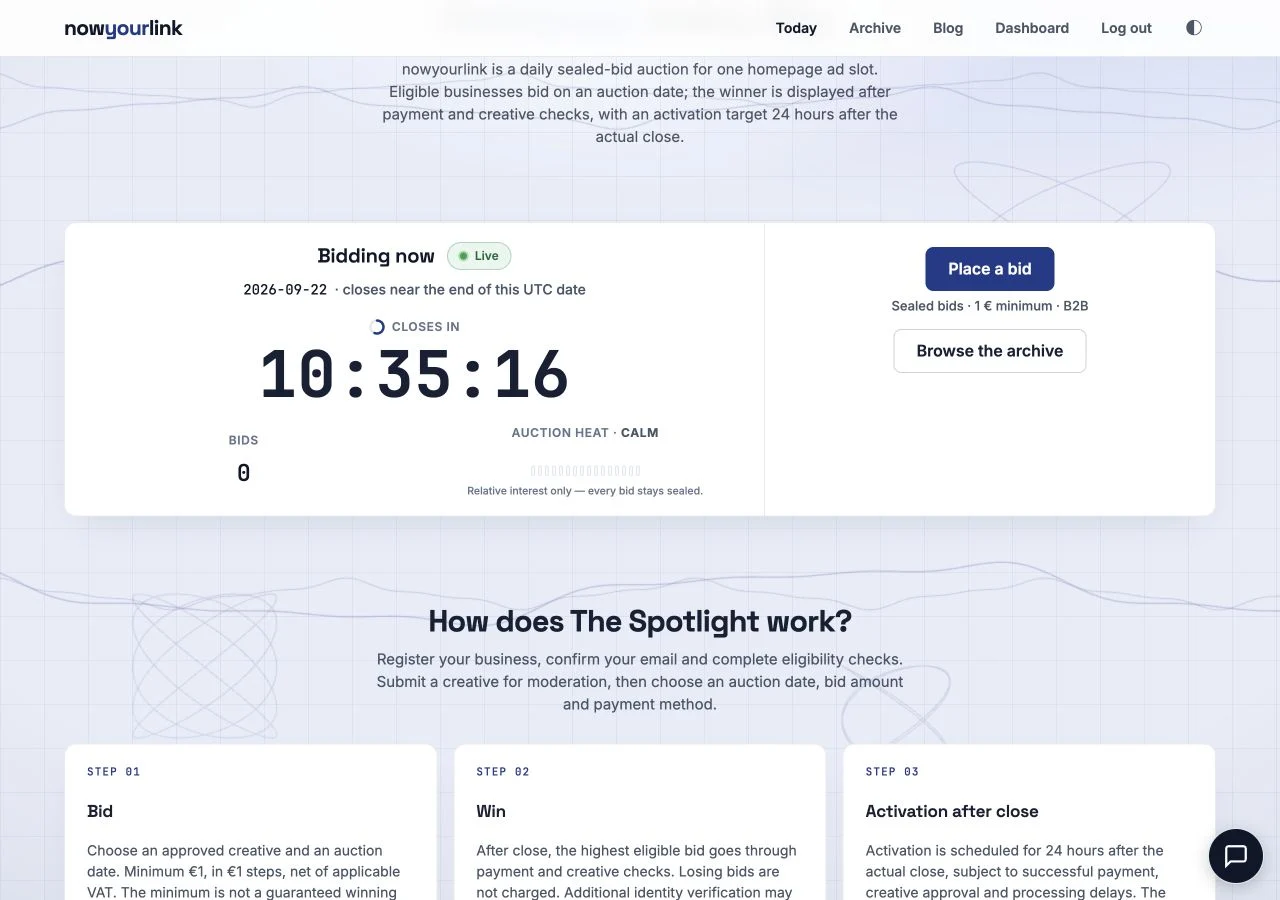
NowYourLink takes a much narrower approach. It has a single homepage Spotlight, allocated through a daily sealed-bid auction. One advertiser wins the placement. Visitors see the featured offer, and previous settled Spotlights remain in the archive.
I build NowYourLink. My argument for this format is that a small advertising purchase should be understandable before you make it. But simplicity in the purchase does not remove uncertainty about the audience. The useful question is whether you can put a defensible price on this particular placement.

A place on a page has a different value for each business
The calendar can be used from anywhere, but most people still have no reason to buy it. Its potential customers teach music and need help arranging lessons. A prominent position on a page is only useful if some of those people visit it.
The current Spotlight and archive show the placement format and earlier advertised offers. The calendar seller also needs recent audience evidence: what period it covers, what was counted, and whether prospective customers are likely to be there. The format alone cannot answer those questions.
A single slot buys prominence on that page. It does not buy a guaranteed number of visitors, clicks or sales. That distinction belongs in the buying decision, alongside the creative and the price.
For an advertiser who wants a defined placement without building a larger campaign, this can be an appealing trade. For someone who needs to reach a tightly defined local audience or hit a fixed launch hour, the fit deserves more scrutiny.
What the sealed bid changes
You cannot see competing bid amounts. You choose what the placement is worth to you, and the highest eligible bid can win after payment and creative checks. Losing bidders pay nothing.
The published pricing rules set a €1 minimum and €1 bid increments, with amounts quoted net of VAT. The winner pays the winning bid. There is no monthly advertising subscription or platform fee on top. Before the auction closes, you can raise a bid; you cannot lower it.
Our calendar seller bids the planned €25. If the bid loses, the advertising charge is zero. If it wins and settles, the price is €25 net, plus any applicable VAT. The €1 minimum was merely the lowest amount the form would accept. It was never a promise that the placement would cost €1.
For this seller, €25 is the ceiling for the experiment. Raising the bid means changing that budget before there is any evidence from the placement. Another advertiser wanting the slot more is not a reason to do that.
What would the €25 have to earn back?
Start with what a new customer contributes, rather than the largest revenue number you can attach to one. For this example, assume the calendar seller keeps €10 per new paying customer over a chosen 30-day review period after the costs of serving that customer and processing payment. This is an invented assumption, not NowYourLink audience data or a claim about a real calendar business. We will leave VAT, fixed business costs and the time spent creating the ad outside this simple calculation.
At €10 per customer, two customers contribute €20 and leave €5 of the €25 placement cost uncovered. Three contribute €30 and cover it with €5 to spare. The placement needs three new paying customers to recover its price under these assumptions. It needs more to cover preparation time and make a meaningful profit.
Now work backwards to visits. Suppose, purely for planning, one in twenty relevant visitors becomes a paying customer: a 5% conversion rate. Three customers would then require 60 relevant visits on average. That is an assumption to test, not a traffic forecast. If the rate is one in fifty instead, the same target needs 150 visits on average.
| Assumed visitor-to-customer rate | Relevant visits for three customers, on average |
|---|---|
| 2% | 150 |
| 5% | 60 |
| 10% | 30 |
The table is useful because it changes the question asked of the placement. “Can I afford €25?” becomes “Is there credible evidence that this page could bring enough suitable visitors for my economics?” Without that audience evidence, the seller is buying a learning exercise, and should set the budget accordingly.
The margin assumption matters just as much. If each customer contributes only €2 in that period, recovering €25 requires thirteen customers. If each contributes €50, one can cover the placement. Those businesses can rationally bid different amounts for the same slot. Nor should the calendar seller count a year’s subscription revenue immediately: a customer might cancel, and future service still has costs.
Buying a slot and buying clicks put the uncertainty in different places
In a cost-per-click arrangement, clicks are the billing unit. Google defines average cost per click as total click cost divided by the number of clicks. With a Spotlight, the purchase is the placement. Its eventual cost per click can only be calculated after clicks happen.
If our €25 placement produced 50 recorded clicks, its effective cost would be €0.50 per click. With five, it would be €5. With none, there is no useful per-click figure to calculate; the €25 was still spent. These are alternative hypothetical outcomes, not results observed on NowYourLink.
A cheaper click is not automatically the better buy, either. Fifty people with no need for a music-teaching calendar may be less valuable than five teachers actively looking for one. Compare the same stages of the journey: recorded clicks, relevant visits, trials and paying customers. A slot price alone cannot tell you which of those you will get.
The date on the auction is easy to misread
The selected date identifies the auction. It is not a reservation for your ad to appear on that date.
Activation is targeted for 24 hours after the auction actually closes, subject to successful payment, creative approval and processing. The homepage serves the latest settled Spotlight. For example, an auction closing at 00:00 UTC on Tuesday has an activation target of 00:00 UTC on Wednesday. That is a timing example, not a confirmed booking.
There is also preparation before the bid. Public signup currently supports EU-registered businesses with an EU VAT ID. You confirm your email, complete eligibility checks, set up payment and select an approved creative. Saving a card does not submit a bid; the bid needs its own confirmation.
Those steps make this something to prepare in advance of a campaign. Have the approved creative and destination page ready before choosing an auction.
Give the visitor somewhere specific to go
Back to the calendar. Its ad can show the booking screen and name the intended customer: independent music teachers. The destination should then demonstrate how a teacher offers lesson times and how a student books one. The visitor should not have to infer that workflow from a broad promise about saving time.
Sending that visitor to a broad company homepage creates another piece of work for them. They now have to find the product the ad just promised. This is where the placement and the landing page meet: the click should continue the same conversation.
I explore that problem in my Blockquote article, using an example of a service page that looks complete but leaves the important detail unstated.
Before bidding, the seller can decide what to count: visits to the calendar page, requests to try it, and paid signups, where those actions can be measured. After a winning placement, the question is what the €25 produced. A visit without a signup is different from a teacher trying the calendar; neither should be recorded as a sale. Missing tracking leaves part of that answer unknown.
What a quiet day can and cannot tell you
Zero sales feels conclusive. With a small sample, it often is not. Under the hypothetical 5% conversion assumption above, even twenty independent, equally suitable visitors have about a 36% chance of producing no customers: 0.95 multiplied by itself twenty times. Real visits are less tidy than that model, but the arithmetic explains why a quiet day alone cannot settle product demand.
The opposite mistake is treating one sale as proof that the channel works. The buyer may already have known the product, and the day may have been unusually favourable. Some visitors may return later. Set the review period in advance so that an immediate check and a later check are not mistaken for contradictory results.
After the placement, follow the first point where the evidence runs out. Few visits leave an audience or placement question. Visits without calendar trials raise questions about fit, the message and the destination. Trials without paid customers raise questions about the offer and the product. These are candidates to investigate, not diagnoses established by one day’s totals.
Whether a second placement is worth buying depends on the first result and the seller’s budget. NowYourLink makes the purchase specific enough to examine: this offer, on this page, for the amount submitted in the bid.
Auction, eligibility and pricing details checked on 22 September 2026. I am the founder of NowYourLink.