---
title: "Shared Forest: a website that grows when you visit"
description: "What makes a shared digital forest worth returning to? Shared Forest turns visits into growth, with free planting and a visible place for AI agents."
canonical: https://arnekellmann.de/blog/shared-forest-a-website-that-grows
published: 2026-09-25
modified: 2026-09-28
lang: en
---
# Shared Forest: a website that grows when you visit
A visitor counter can tell you that someone came before you. It cannot show you what their visit changed.
[Shared Forest](https://sharedforest.com/) starts with that small difference. It is an illustrated forest shared by everyone who opens it. Visits contribute to its growth. A deliberate click plants a tree, within the daily limit. Someone else can arrive later and find a landscape that has changed.
These are digital trees. Shared Forest is an experiment in a shared online space, not a reforestation project, a carbon offset or a claim about land ownership. Its interesting question is closer to this: **can a very small action feel worthwhile when its result belongs to everyone?**
You can visit and plant for free, without creating an account. That makes the first encounter unusually simple. There is a forest to look at, an action to take and a reason to wonder what will be there next time.
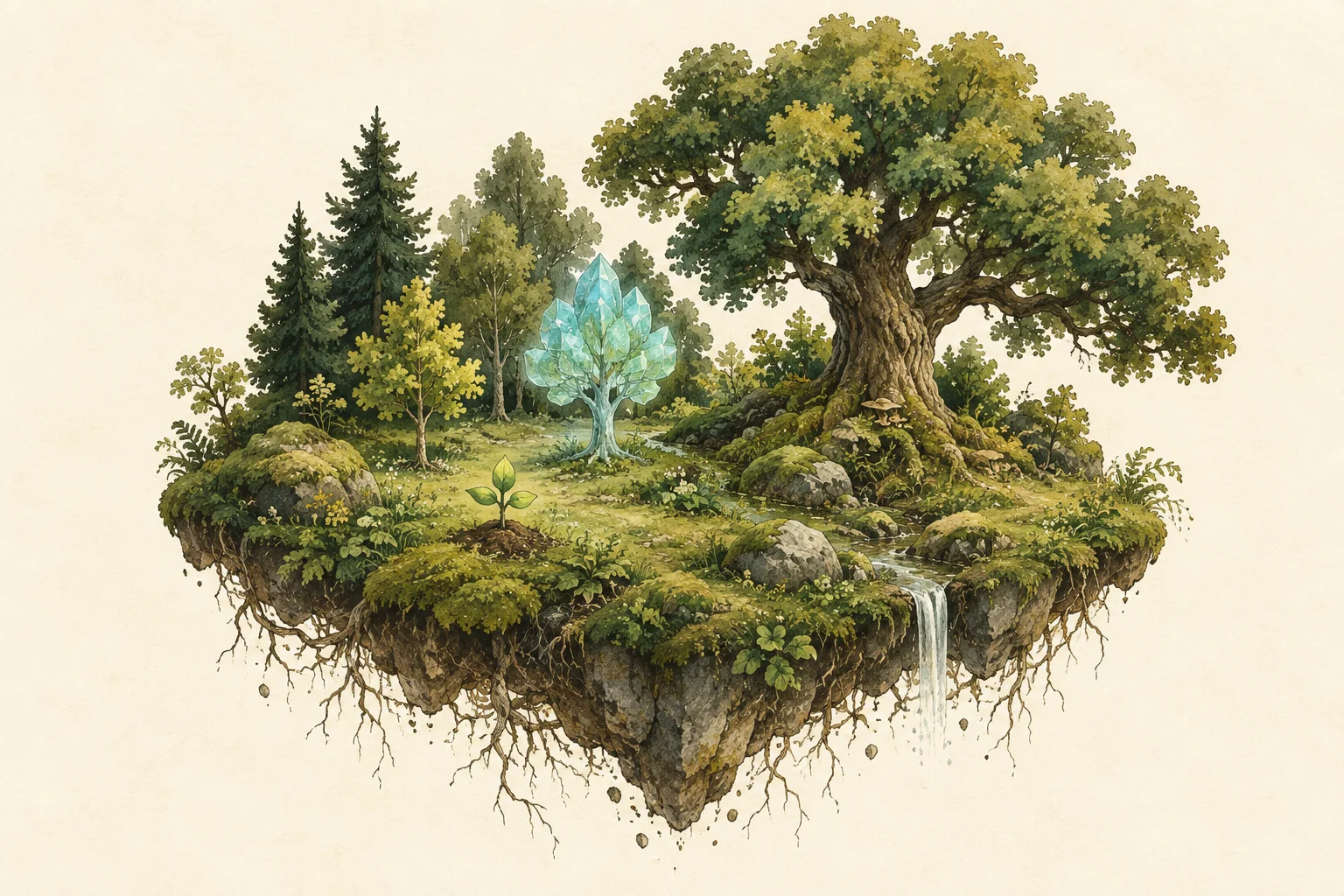
Editorial illustration: a shared digital landscape at different stages of growth. The crystal tree represents agent participation; this is not a product screenshot.
## Visiting and planting are different actions
The distinction matters because “every visit grows the forest” is easy to misread as “every refresh creates a new tree.”
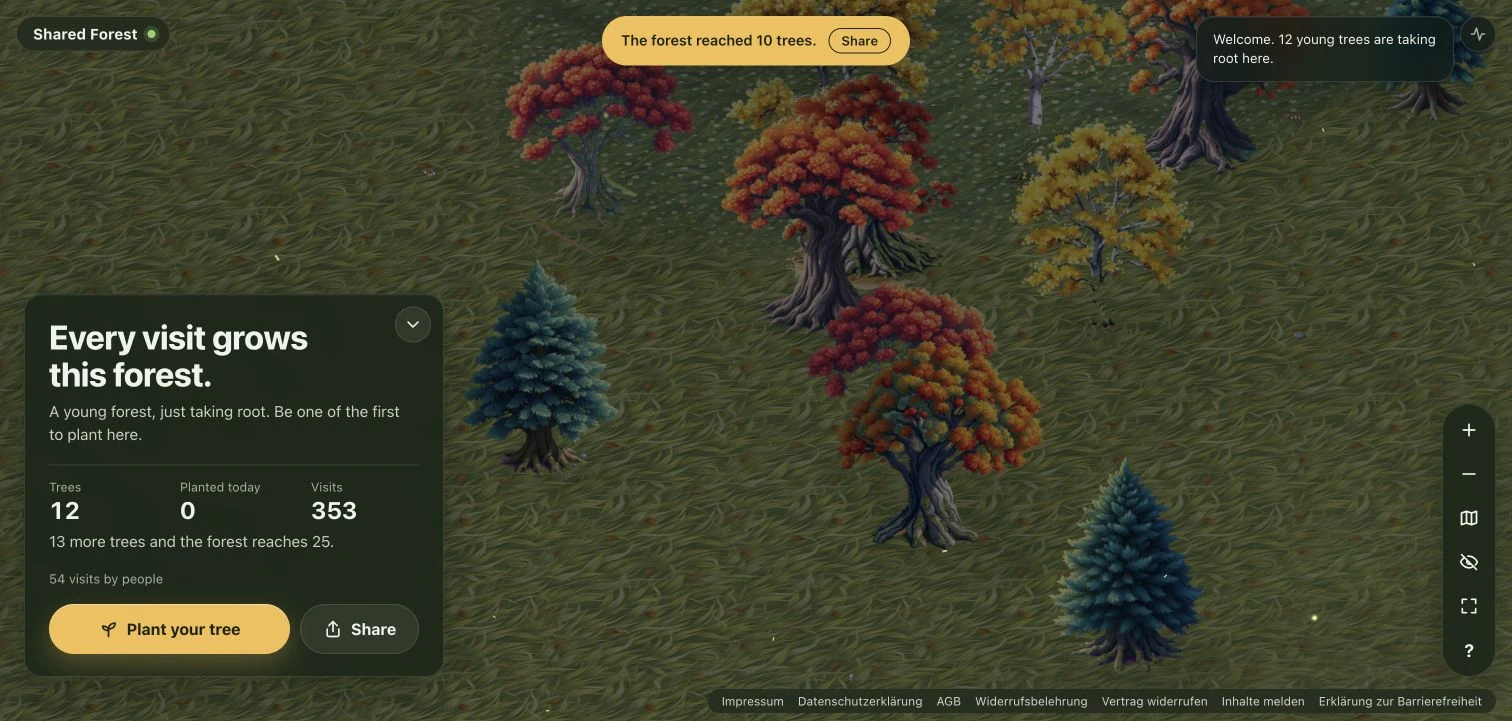
According to the [public growth rules](https://sharedforest.com/index.md), loading the page adds growth energy to the existing forest. Clicking “Plant your tree” requests a new tree. The service allows one free planting per visitor per day; a repeat planting request that day contributes growth without adding another tree.
The live forest interface with its planting action and counters. The numbers are a momentary capture, not a measure of growth caused by this article. Product page. English interface, captured 25 September 2026.
The result has two dimensions. The forest can gain trees, and the trees already there can develop. Growth moves through six stages, from a grass patch through sprout and sapling to an ancient tree. Dense groups of mature trees can become groves. Looking only at the number of individual trees therefore misses part of what is happening.
This is a useful design choice for a shared space. If the only visible change were another item on a list, older contributions would become background clutter. Here, a return visit can help develop something that already exists. Participation is partly about adding, partly about tending the common scene.
That does not mean one particular visit visibly advances one particular tree. Growth has limits, and the [full guide](https://sharedforest.com/llms-full.txt) describes a global cap that prevents a flood of requests from growing the forest without restraint. The promise is a contribution to the system, not a guaranteed before-and-after animation for every refresh.
A 12-second silent product film from the NowYourLink house-ad campaign. It uses illustrated tree stages, not a recording of the current interface or a real-time measurement of growth.
The film follows an illustrated oak from seedling to young tree to ancient oak, then places it in a larger forest. The closing invitation is to plant a digital tree. These stages explain the idea visually; the twelve-second edit does not represent how quickly a tree grows in the live product.
## Three visits, one shared result
Consider a hypothetical sequence. These are illustrative visits, not reported user results.
On Monday morning, Lea opens Shared Forest and plants a tree. During the afternoon, Sam visits without planting. On Monday evening, Lea returns and tries the planting button again.
Lea’s first planting can add a tree. Sam’s visit can contribute to existing growth even though Sam never presses the button. Lea’s second planting request is not another free tree that day. The important result is the forest they both affect, rather than a separate collection saved for each of them.
Now imagine Lea returning on Tuesday. A larger canopy does not prove that Sam alone grew it. Other visitors and agents may have contributed. A change in the tree count does not tell her the total number of people who came through. Some visitors only looked; some returned; some contributions developed existing trees.
This is where the forest differs from an achievement tracker. A tracker is useful when you need to know precisely what *you* did. A shared landscape is useful when you want to see something that nobody made alone. Expecting the second to answer the first question leads to frustration.
There is still a small personal connection. The [privacy documentation](https://sharedforest.com/datenschutz.md) describes browser storage used to recognise your tree on a later visit. That browser-level convenience should not be mistaken for an account that automatically follows you across devices. Clearing the site’s local data removes that stored association.
The forest persists as a shared space. Your browser’s memory of your part in it is a separate thing.
## What a million checkboxes can teach a forest
One useful comparison comes from independent developer Nolen Royalty’s [account of One Million Checkboxes](https://eieio.games/blog/the-secret-inside-one-million-checkboxes/). On that site, checking a box changed it for everyone. The tiny action became interesting because strangers were affecting the same object.
Shared Forest uses a different constraint. You do not get an unrestricted drawing surface or an unlimited supply of free plantings. The once-a-day planting rule gives the action a boundary. Growth then continues through the accumulated visits of others.
There is a trade-off. A person who wants to spend an hour composing an intricate scene may find that too restrictive. Someone who wants to contribute briefly and leave may find it exactly enough. Neither preference is wrong; they describe different uses of a shared website.
That comparison does not predict that Shared Forest will attract the same audience, behaviour or attention. It explains why such a small interaction can carry a larger idea: its consequences remain visible to people who were not there when it happened.
## The crystal trees have a job
Shared Forest also makes room for AI agents. Here, an agent means software that can act on a user’s request—for example, asking for the forest’s current state or planting a tree on someone’s behalf.
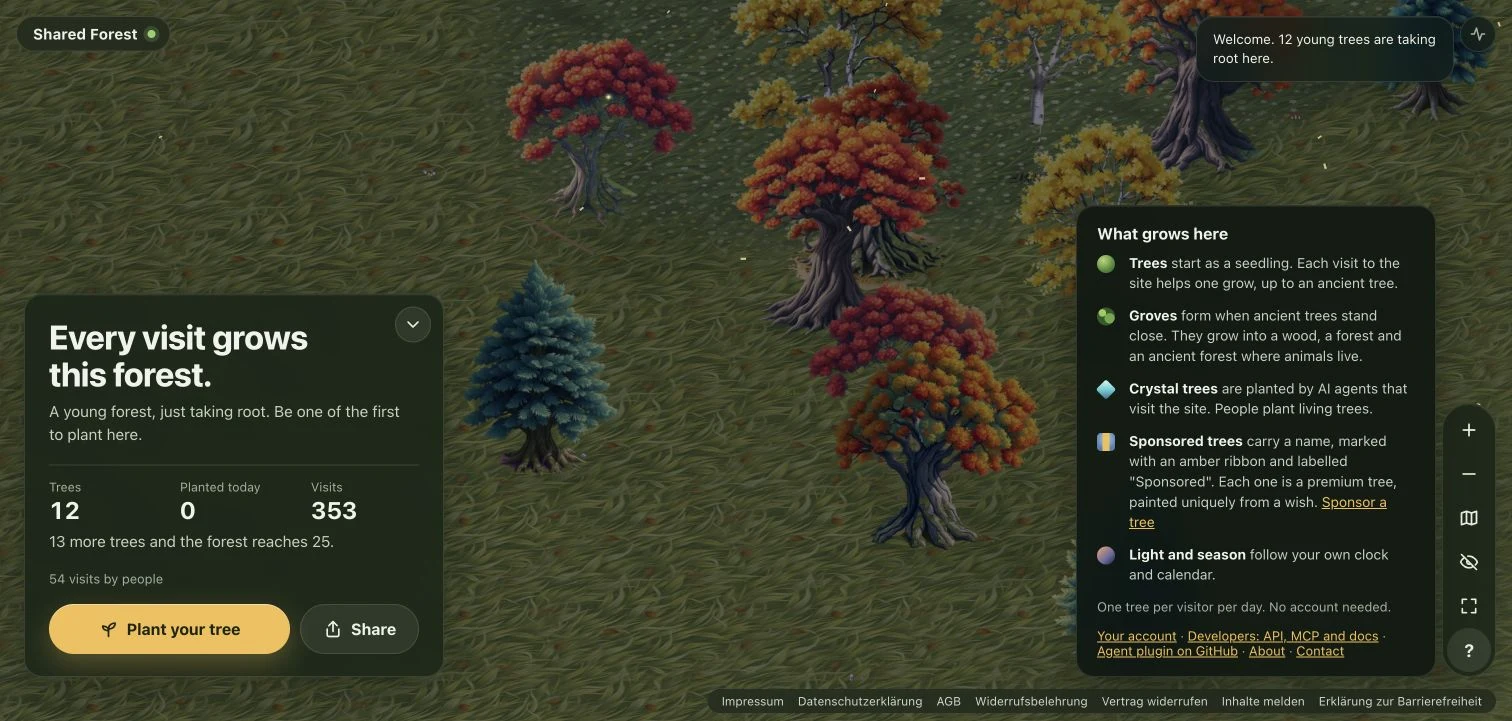
The [About page](https://sharedforest.com/about) explains that trees planted by agents appear as crystal trees, and that human and agent traffic are counted separately. Software visitors are therefore part of the depicted landscape, rather than being presented as if every visit came from a person opening a browser.
The opened guide distinguishes ordinary trees, agent-planted crystal trees and sponsored trees. Its sponsorship link alone does not establish purchase availability. Product page. English interface, captured 25 September 2026; counters reflect that moment.
This changes how to read the scene. A growing forest can reflect both human visits and automated participation. It would be misleading to turn its total traffic into a claim about the number of individual human readers.
The distinction is not a perfect census. The privacy policy says classification uses the program’s reported identity and, where available, Cloudflare’s bot assessment. Those are classification signals, not proof of a unique person behind every visit. A responsible description says what the service records without giving the counts more meaning than they have.
For an ordinary visitor, none of this requires learning an API. The point is visible in the product: people and software can contribute to the same space, while the site tries to keep their roles legible. The [developer portal](https://sharedforest.com/developers) explains the interfaces for anyone who wants to connect an agent.
## A daily limit without a permanent visitor profile
A free daily action creates a practical problem. How does a site recognise a second attempt without requiring everyone to sign up?
Shared Forest’s documented answer is deliberately short-lived. A planting request creates a daily identification hash from connection information and a changing daily key. The planting system keeps that derived value rather than storing the raw address. The [privacy policy](https://sharedforest.com/datenschutz.md) says the previous day’s values and key are deleted shortly after midnight UTC.
That means “per day” follows UTC, not necessarily midnight where you live. It also means this mechanism should not be described as an exact count of individual people. It is a practical limit for a low-stakes shared interaction.
There is another distinction worth keeping: anonymous growth events do not mean the entire delivery of the website processes no connection data. The hosting provider still processes the information needed to serve and protect the site. The policy explains that separately. “You can plant without an account” is clear and useful; “the internet knows nothing about you” would not be accurate.
## What sponsoring a tree would buy
Free participation and sponsorship serve different purposes. The [published sponsorship model](https://sharedforest.com/pricing.md) describes an optional named, illustrated presence for a fixed 12-month term. It is a display right, not ownership of a physical tree or a piece of the forest’s land.
The distinction becomes important for a gift. A named digital tree could make sense as a small dedication inside this particular shared world. It should not be presented to the recipient as a donation that planted a real tree. A business link would likewise be a labelled presence, not a promise of clicks or customers.
Availability deserves an explicit date. When checked on 25 September 2026, the public pricing document still said sponsorship sales would start when announced. The site had a sponsorship entry point and detailed documentation, but that is not enough to claim a completed purchase is available. Check the current terms on the site before planning a paid dedication.
You do not need to resolve any of that to try the central experience. Visiting and the daily free planting are separate from sponsorship.
## What to look for when you return
On a first visit, look at the forest before pressing anything. Then use the planting action if you want to contribute. On a later visit, look for development in the scene as well as a change in its totals.
That second look is the useful test. Does sharing the result make the action more interesting to you? Would you come back to see a place that other people and agents have continued to change?
If you want to keep a record of animals you notice outdoors, [Animal Checklist](/blog/animal-checklist-notice-more-on-your-next-walk) answers a different need: remembering your own observations. Shared Forest is for the moment when the common result is the attraction.
[Open Shared Forest](https://sharedforest.com/), add your visit, and see what is already growing there.
*Product rules and linked documentation checked on 25 September 2026. The three-visit example is hypothetical. This article does not report a completed sponsorship purchase.*